
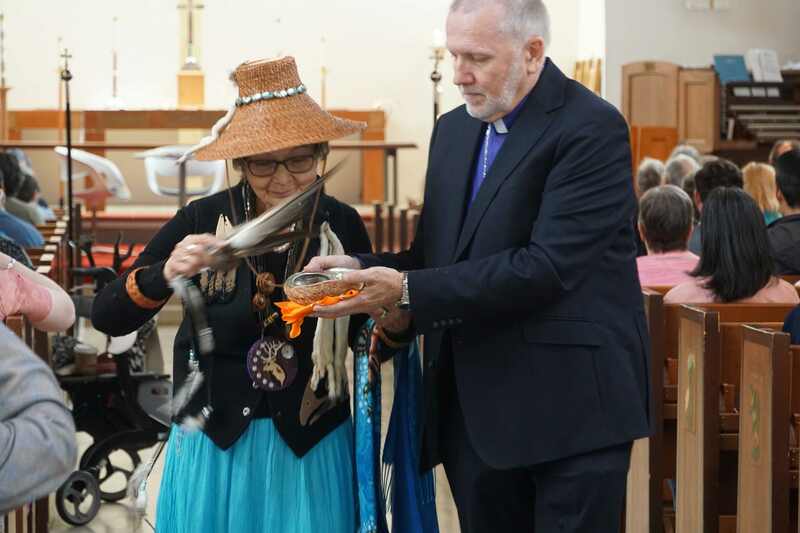
The land on which we have gathered, where your feet are currently resting, has been holy and sacred land since the beginning of time and even before that. Holy land that the Spirit swept over and around and through and has continued to do so ever since.
The land on which our Diocese sits was land that was inhabited, cared for and protected by a number of different Indigenous groups prior to the colonization of this area. We acknowledge the sad history and we continue to offer our apologies in response to a number of different acts that were carried out here. Land taken, residential schools, reservations set up, the arrival of new illnesses coming with the immigrants, banning of the potlach, murdered and missing Indigenous women, girls and two-spirited people and many, many others.
That is part of our history and it is important to recognize and name this. And we do. We affirm that the Anglican Church was part of this. Reconciliation involves many steps along a pathway and we know that we are being called forward.
We also recognize that those who have come here in more recent times have created a history in relation to the Anglican Church in the Province of British Columbia that has brought us to this time and this place. This Diocese of New Westminster was established in 1879 as a separate diocese from what was prior to that the Diocese of British Columbia, incorporating the entire province. The see city at that point was, of course, New Westminster, but the province was seeing enormous growth and change in so many different regions. Vancouver itself was growing rapidly and in 1929 the see city was moved from New Westminster to Vancouver, the Cathedral then moved from Holy Trinity New Westminster to Christ Church Vancouver. This was a significant change as it was recognized that the Anglican Church needed to respond to enormous population growth taking place in this part of our province.
This is what I want all of us here to pause and consider. In 1879 this diocese was formed, 147 years ago. And then 50 years later, almost 100 years ago, adjustments needed to be made to recognize that the Anglican Church needed to respond to the spiritual needs of the growing, changing and developing population around us. My point is that we have always needed to change, grow, adapt, re-think, re-new and pay attention to the Holy Spirit in our time and our place and our situation and our calling. This is a quick snap-shot of our history but it has always been the history of the Church, to pay attention to where the wind and fire of the Holy Spirit was leading and trust enough to follow. To adapt, re-think and renew as situations change and re-form.
And this is what is taking place in these times and this place. Things are changing and we are seeing the Holy Spirit continue to bring fire and wind and renewal and invitation to us to re-purpose as she has always done and always will. We believe in the Holy Spirit not the Holy Predictable One, not the Holy Defined One, not the Holy Vanilla One… there is a big difference. And so we buckle up and realize that we are being invited or maybe nudged or even pushed to recognize this Spirit in our midst who is calling us forward. Not to simply pay attention to our history but to see that we are being called to a new future.
There have been predictions made that the Anglican Church in Canada will die out by the year 2040… or 14 years from now. Look around you, you know very well that this absolute nonsense. We are changing, we are renewing, we are responding to the call of the Holy Spirit for our times but we are not dying out. We have far too much to do in response to the gospel of Jesus Christ.
The five marks of mission that many of us have been hearing about for a good few years, stated this as our calling:
• To proclaim the Good News of the Kingdom
• To teach, baptize and nurture new believers
• To respond to human need by loving service
• To seek to transform unjust structures of society, to challenge violence of every kind and to pursue peace and reconciliation
• To strive to safeguard the integrity of creation and sustain and renew the life of the earth
We have far too much to do in relation to these five marks of mission to simply close up shop in the next 14 years. We have gospel work to do in terms of proclaiming, teaching, baptizing, nurturing, responding, seeking and striving. Jesus, this Jesus that we follow is not calling us to start packing things up but rather to making room for more. The Jesus who called us to love our neighbour, love our enemies, feed the hungry and offer a glass of water to the thirsting, who called us to be salt and light in this world, this Jesus is not going to be satisfied if we simply close everything down. That is not our calling and our future.
And we are seeing this in the Diocese. I travel around this diocese a lot and I have come to see so many different ministries, programs, outreach, teachings. Baptisms, confirmations, reaffirmations, receptions, ordinations with a bunch of people who don’t seem to realize that we are only waiting to turn off the lights. Because we are focussing on the calling of Jesus and the gifts of the Holy Spirit we are seeing a renewal of so many aspects of living the faith. Pentecost, the arrival of the Holy Spirit is about every day, every day we recognize that the Holy Spirit continues to bring wind and fire.
The pandemic was a difficult time in all churches all around the globe. And in the time following, many churches saw reduced attendance and connections in their parishes. For a couple of years. But in more recent years we are seeing a complete shift. Overall our Diocese is growing, we are seeing more people in our churches than we have for quite a while. Some churches are growing quite rapidly with people from all over the world. Some churches are responding incredibly to the needs, usually to do with food scarcity, of people in the surrounding neighbourhoods. Some churches are seeing renewed interests in learning about Anglicanism or the Bible or Spirituality. Some churches are seeing renewed possibility in how they use their land or buildings to reconnect with the surrounding neighbourhoods. There is much good news. I know that some parishes are seeing decline and that is stressful and worrisome for the congregation… but I do wonder if they will see this renewal soon in their churches as there seems to be a reawakening to spirituality, to a relationship with Christ, to the liturgical life of our congregations, to our approach to living out the gospel in expansive ways.
Because it seems in the world that many around us are hungry and seeking something … something more. There are many who are spiritually hungry wanting to know about the love of God in these days of so much uncertainty in the world. There are many seeking a connection to the deep liturgical history of our church that speaks in ways that words alone cannot. They are seeking hope when so much around us seems to rob us of hope and possibility and a renewed focus on the true purposes of life. They are seeking a relationship with the Creator, with the Son, with the Holy Spirit.
These current times in our world, with hope and compassion being snuffed out, are creating a famine for the bread of life, and we offer that bread, that gift of God for the people of God each day and each week.
The Anglican Church, despite our mistakes, the wrongs we have committed, the mis-steps, the sins, despite all this, the Anglican Church, this Diocese of New Westminster is responding to that wind and fire of the Holy Spirit that we celebrated last week. We have a calling and we are living into that calling because this is what God seeks of us. We are resurrection people living into the hope, grace and love of God as seen in the resurrection of Jesus. For we have good news to share and we are living into this.