A Pioneer Whose Ministry Opened Doors for Women

By Andrea Montgomery DiMarco
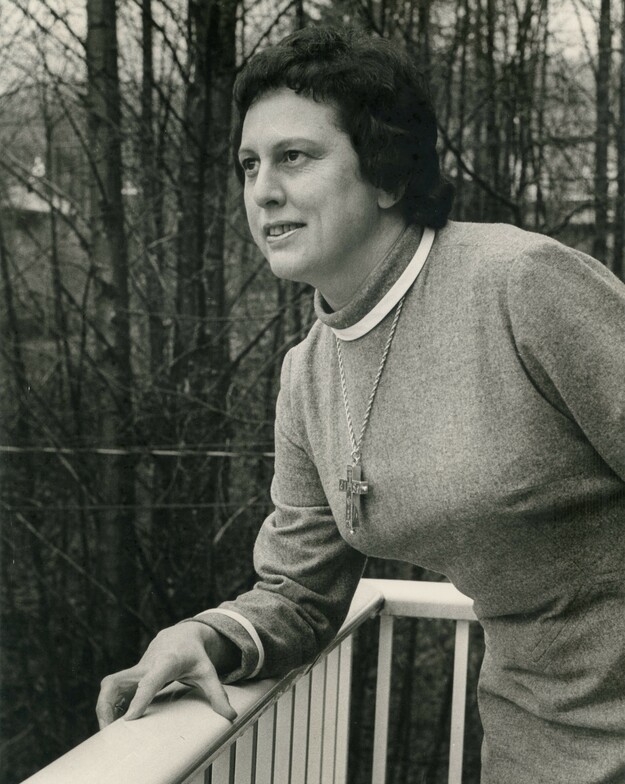
When the Rev. Elspeth Alley walked into Christ Church Cathedral in Vancouver on November 30, 1976, she was stepping into history.
Alongside the Rev. Virginia Bryant, Alley became one of the first two women ordained to the priesthood in the Diocese of New Westminster. Across Canada, six women were ordained that same day, following General Synod’s decision earlier that year to authorize the ordination of women as priests.
It was a moment of celebration, but it was also a moment of conflict. For Alley, the journey to the priesthood had not been easy. Years earlier, while still a deacon, she had written words that revealed both the weight of what lay ahead and the faith that sustained her:
“It is hard to be the first in anything. If ordination to the priesthood should come to me, it will come because it is the will of God.”
Nearly 50 years later, her story remains a powerful reminder of the courage required to open a door long closed to women.
An historic day
Cathedral Parishioner Susanne Cruickshank was among those present for Elspeth Alley’s ordination, and she recorded her experience in her personal diary. Her account captures the tension of the day. During the service, the Rev. Jim Pennrice came forward and formally presented written objections to the ordination. He read the objections from a scroll and handed it to the bishop. The bishop received it and announced that the service would continue. Pennrice then left the church. Cruickshank wrote of feeling “angry” and “degraded” that such opposition to women’s ordination existed within the church she loved. Yet she also recognized something larger happening before her eyes: a church wrestling with change and, in her words, responding faithfully to “the groaning and challenge of the Holy Spirit.”
There was another striking image that evening. A large group of male priests gathered around Alley and then Bryant, extending their arms to bless the newly ordained women. To modern eyes, the scene could appear to symbolize the patriarchy that had defined the church for generations. But Cruickshank also recognized that these were the men who would become Alley and Bryant’s colleagues and supporters in ministry.
When the bishop presented the three newly ordained priests — Alley, Bryant and the Rev. Michael Deck — the congregation erupted in applause. “People clapped and clapped!” Cruickshank wrote. Alley cried. So did many others.
For the remainder of the service, Cruickshank described a remarkable sense of acceptance, as though women had always belonged in the full ministry of the priesthood. At the communion rail, she reflected on what the moment meant for the generations that would follow. She thought of her own children and gave thanks that they would grow up seeing women serving as priests — and that, for them, it would simply be normal.
A priest at St. Faith’s
Alley’s historic ministry also has a special connection to St. Faith’s. She served as a deacon associate and curate at St. Faith’s from June 1975 until February 1977. In December 1976, only weeks after her ordination, she celebrated her first Eucharist as an ordained priest in the parish. For those at St. Faith’s, this was not simply a historic event taking place somewhere else. The woman who had helped lead and serve their congregation had become one of the Anglican Church of Canada's first women priests.
Her ministry was part of a much larger transformation within the church—one that would eventually make women priests commonplace in Anglican congregations across the country. But in 1976, it was anything but commonplace.
A name that became a home
In 2012, another chapter in Alley’s story began when a residence for older women opened on the grounds of St. Margaret of Scotland Church in Burnaby. The former Abbeyfield House was transformed into Elspeth Alley Housing for Elder Women, a 23-unit residence for older women who were homeless or at risk of homelessness. The project was a partnership involving Atira Women’s Resource Society, the Anglican Diocese of New Westminster and the provincial government. The residence provided not only housing but support services, including a live-in coordinator, life-skills education and training, and treatment support.
At the time, Atira CEO Janice Abbott described the new facility as an important resource, particularly because it provided housing for older women outside Vancouver’s Downtown Eastside. The residence was named for Alley because of her pioneering role as one of the first women ordained as a priest in the Anglican Church of Canada and the first woman ordained in the Diocese of New Westminster.
A legacy of opening doors
A striking connection links the two chapters of Elspeth Alley’s legacy. In 1976, she helped open a door within the church. Decades later, her name was attached to a place designed to open another kind of door—a door to safety, dignity, and a home for older women vulnerable to homelessness. The struggles are different, but the underlying principle is remarkably similar: creating space for women to live with dignity, purpose, and belonging.