Pilgrims Together:

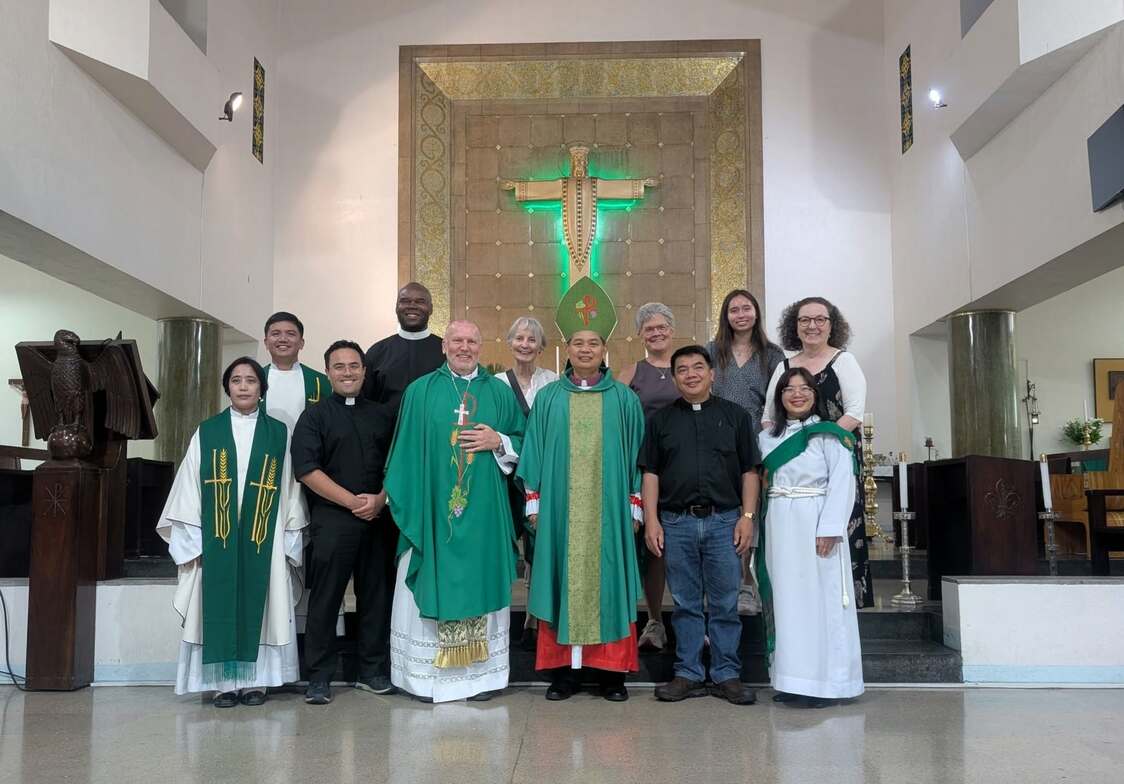
This article was written by the Rev. Simbarashe Basvi
More Than a Visit
When I boarded the plane in Vancouver with fellow pilgrims from the Diocese of New Westminster, I thought I was travelling to visit a partner diocese. Looking back, I realize that I was embarking on a pilgrimage. I call it a pilgrimage not because I was visiting an ancient Holy Place, but because I was making a journey of faith. As Ian Bradley observes, pilgrimage is “a departure from daily life on a journey in search of spiritual well-being.” I encountered God not only in churches and worship services, but in mountain villages, on winding roads, around dinner tables, in rice terraces, and in conversations with people whose faith has been shaped by both hardship and hope.
I returned not simply as someone who had visited a partner diocese, but with a renewed sense that pilgrimage is not determined solely by where we go. It is determined also by how we go, what we seek, whom we encounter, and how the journey changes us.
What follows are not simply memories from a trip but moments that continue to challenge and shape my understanding of discipleship, mission, and the Anglican Communion.
"We Actually Turned Them into Beggars"
One of the most significant moments of the pilgrimage happened before we ever reached the EDNP. In Manila, we were welcomed by Prime Bishop Nestor Poltic and Attorney Floyd Lalwet. They shared the story of E-CARE and the Church's development ministry ABCD (Asset Based Community Development).
At first, it sounded like many development stories I had heard before. Communities faced poverty, and the Church responded by funding projects and providing assistance.
Then Floyd paused and made a statement that immediately captured my attention. "We actually transformed them into beggars." The room fell silent.
He was describing a painful lesson learned through years of well-intentioned development work. Communities had received grants and assistance, but over time many were hit by donor dependency syndrome. Whenever disaster struck, they returned asking for more help. The Church realized that despite good intentions, dependency sometimes replaced empowerment.
What emerged instead was the Asset-Based Community Development approach. Rather than beginning with what people lacked, the Church began with what people already possessed. The church looked at their skills, relationships, knowledge, land, creativity, and faith. The question shifted from "What do you need?" to "What has God already placed in your hands?"
This challenged me to think seriously about the uncomfortable phrase, “We made them beggars.” There is a danger that, even with the best intentions, churches and organisations from wealthier contexts can approach communities primarily by identifying their needs. Then they provide what they believe those communities lack. Over time, this can create a relationship in which one side
becomes the giver and the other the receiver. Instead of developing confidence and local capacity, we can unintentionally create dependency. We can make people feel that they must continually ask for what they need rather than recognise and use what they already have.
What I witnessed in Northern Philippines offered me a different way of seeing mission. I saw churches being constructed in communities where resources were limited, but I did not simply see buildings waiting for outside funding. I saw people contributing their labour, skills, land, relationships, creativity, generosity, and faith. What they had was being brought together for the building of the Church. The physical construction became a visible expression of something deeper: people were not simply waiting to receive; they were participating in creating.
This brought me back to Moses in Exodus 4:2, when God asked him, “What is that in your hand?” Moses had a staff. It was an ordinary object, something he already possessed. God did not begin by telling Moses what he lacked. God began by helping him recognise what was already in his hand. The staff became an instrument of God's mission.
For me, this is at the heart of ABCD and also at the heart of what I learned through this pilgrimage. The question “What do you need?” is not necessarily wrong, but it should not be the first or only question we ask. We also need to ask, “What has God already placed in your hands?” When we begin there, people are no longer viewed primarily as recipients of charity. They are recognised as people with gifts, dignity, agency, knowledge, and something valuable to contribute.
The churches under construction remain a powerful image for me. They represent more than bricks, timber, concrete, and physical structures. They represent communities
As I listened to Floyd, I found myself thinking about Jesus feeding the five thousand. The disciples focused on scarcity. Jesus focused on what was already available: five loaves and two fish.
The lesson continues to challenge me. In parish ministry, it is often easier to see what is missing than to recognize the gifts already present. The E-CARE story reminded me that one of the Church's most important tasks is helping people discover the abundance God has already entrusted to them.