Planting Churches in Unlikely Places

A group of eight delegates from our diocese arrived in Manila on August 1, ready to make connections and renew acquaintances. We were warned, prior to landing, that this was the rainy season in the Philippines, and it certainly was! We had rain on each of the next ten days, but it did not dampen our spirits or squelch our enthusiasm. We were all keen to learn more about the growing and developing Episcopal Church in the Philippines, part of our Anglican Communion.
While we were in Manila, we had a chance to learn about the national church and spend some time with the Prime Bishop, the Right Rev’d Nestor Poltic. Our meeting happened at the national office and the national cathedral. We learned more about the link between WeCare and Alongside Hope. The two organizations are supporting better agricultural practices and seeking new financial supports for small businesses.
From Manila we made our way to Bontoc, the see city of the Episcopal Diocese of Northern Philippines (EDNP). It was good for me to reconnect with Bishop Benny Lang-akan and a number of the clergy of the diocese. We heard many stories about the growith happening in various ways in the diocese. Specifically, we heard aout the growing number of churches, of ministries in rural settings, of Bible Studies being offered, money being shared in to help with the building of new church buildings, and the number of seminary students preparing for ordained ministry.
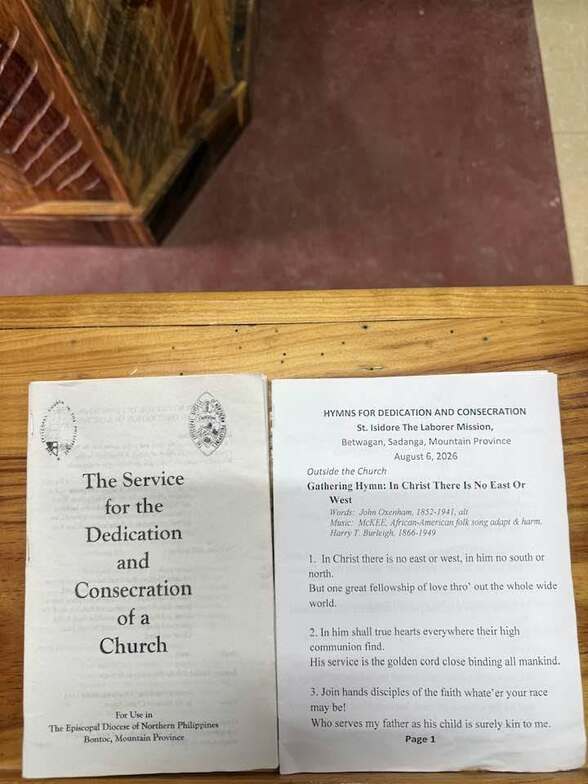
In the Philippines, rather than talking about or describing projects, the people of the diocese preferred to show us what life is like there. So on August 8, despite the difficult weather of a typhoon in the area, we headed to a small, rural parish where the newly built church in Betwagan was to be consecrated. We had to drive from Bontoc to a parking area and then set out on foot to walk beside the river to get to the community. It was a difficult hike because of the amount rain and the rising river. But the welcome at the new church had us forgetting the arduous journey very quickly.
This was a church that had started out three years prior with a few people in a small residence. The congregation grew rapidly and consistently as more families learned about the gospel of Christ and the community of his followers. As the numbers grew, a more permanent structure was needed to serve as the parish centre. Construction in a remote setting is difficult in any part of the world. But here many of the materials had to be carted in by hand or whatever form of lift could be devised to cross the river or be brought over the local mountains.
EDNP has a number of approved architectural designs for new churches. They also have two engineers on staff at their Synod Office. Soon, with money raised and money borrowed from the diocese, the formation of the shell of the building began. In EDNP (and other parts of the Episcopal Church in the Philippines), they use a program known as Receivers to Givers. Essentially this means that the funds needed to build a church are offered through the diocese. Then that church must pay that back to help fund another church being built elsewhere in the diocese. This has been successful and allowed for the construction of a number of new worship spaces.
Back in Betwagan, it did not take long for the roof to be in place and the windows installed. The space was bright, and has a view of the river and the surrounding rice fields. The church was located in a central area of this this agriculturally based village, speaking of invitation and community. All that was missing at that stage was the consecration of this new church.
Despite the oppressive weather on the day we were there, Bishop Benny arrived. After drying off from the hike in, all involved in the liturgy were vested and ready to start. St. Isadore’s was to be consecrated or blessed in God’s name and for God’s ministry. The church was packed on that day with children, youth and adults anticipating a moment in history not soon forgotten.
The consecration of a church involves prayers of blessing on the building, the doors, the windows, the pews, the lectern, the pulpit, the tabernacle, the font, the altar, the linens, the candles and all other necessary items for our Anglican worship. The altar itself was a huge slab of wood cut from a local tree, impressive for its beauty and its statement of linking the earth with the church, and the Creator with the called.
We moved into a liturgy of the Eucharist. We all gathered at the altar to once again be like those first disciples, ready to receive the body and blood of Christ, which would feed us to continue to live into the gospel both at St. Isadore’s and well beyond. After the service, it was time to feast with music, food and dance.
The whole experience reminded me of what it might have been like in our Diocese of New Westminster during the times when so many of our churches were built. Things have changed since those days when we remember full churches for a consecration liturgy. But we are also going through something similar now. Many churches are growing and renewing and being enlivened by the Holy Spirit and new faces. We are seeing possibility right in front of us. Indeed God is calling us anew to live into the gospel of Jesus and that it may be enlivened by us.