God is Calling Us to a New Future

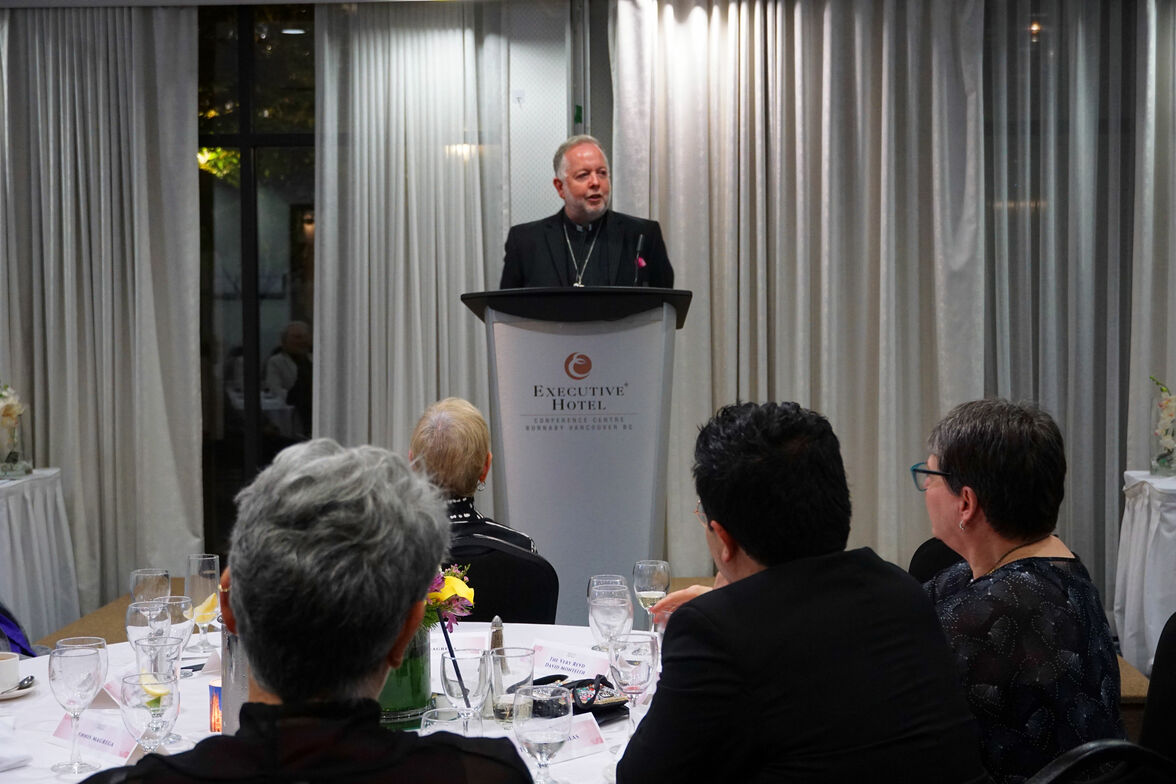
As the church responds to the call to be God’s presence in the world of today, new realities and new types of needs can arise. In some cases those are needs that previous church structures could not have dreamed of. The Bishop’s Discretionary Fund is one tool Archbishop John Stephens can use to respond to the new needs of the church in the Diocese of New Westminster. On Thursday October 23 a fundraising dinner, the Bishop’s Friends Dinner, took place in support of that fund.
It is, of course, not only the local church discovering new ways of speaking to the hearts and minds to the people of today. Dean David Monteith of Canterbury was the guest speaker at this year’s Bishop’s Friends Dinner. He reflected on the history of Canterbury Cathedral and how its history highlights key aspects of the mission of the global church.
One of the Most Important Stories in the World
Canterbury Cathedral was established in 597 by Augustine of Canterbury, a missionary who had been sent by Pope Gregory the Great to bring Christianity back to Anglo-Saxons. “Not all has been plain sailing, then or now,” said Dean Monteith, summarizing the cathedral’s history. in 1170 then-Archbishop of Canterbury, Thomas Becket was in conflict with King Henry II regarding the rights and privilleges of the church versus the rights and privilleges of the king. Becket was killed as a result of that conflict and his bones are at Canterbury Cathedral. Very shortly after his death people began going to Canterbury to venerate his bones. Monks at Canterbury recorded the stories of those who came to venerate Beckets bones and found healing. As a result, Dean Monteith said, “we know their names, we know where they lived,” and they were included in the Cathedral’s “Miracle windows” depicting the healings. Academics have since noted that whether the illness was physical, emotional, or spiritual, “in no instance is the person alone,” said the dean.
This pushes us to think about differences and difficulties in the communities we are in, according to the dean. “What would it mean to go alongside that?,” he asked. Dean Monteith said he sees that question as the most crucial part of “what Canterbury is about, what I am about when I’m away from Canterbury.”
Never Been Plain Sailing
Shifting gears, Dean Monteith reflected on the recent election of Dame Sarah Mullally as the next Archbishop of Canterbury. He noted she was Chief Nursing Officer in the Department of Health in her 30s, and was made a Dame Commander of the British Empire in her early 40s. “She has experience with complex systems,” he said. She became Bishop of London in 2018, a diocese which, Dean Monteith noted, has the highest number of parishes that do not accept the ordination of women. Her experience in health care prior to her ordination, and in her priestly and episcopal experiences “stand her in good stead” to serve as Archbishop of Canterbury.
Archbishop John Stephens briefly addressed guests, thanking everyone for their support and outlining the ways the Bishop’s Discretionary Fund supports the ability of the church to do as Dean Monteith commented, “come alongside” those seeking God’s presence.
Archbishop Stephens noted that across the diocese, for the most part, parishes are experiencing an increase in attendance and various ministries seeing revitalization after embracing new ways of engaging in their mission. “The world of these days is in desperate need of Gospel wisdom”
“I am confident God is calling us to a new future,” the archbishop said, adding that the Bishop’s Discretionary Fund has allowed the diocese to support clergy and ministries in the diocese, nationally and internationally, as they respond to that call.